
Photo by Terence Faircloth Decription by Wally Gobetz
The Breakers Palm Beach was first opened by Henry Flagler on January 16, 1896 to accommodate travelers on his Florida East Coast Railway.
Originally known as the Palm Beach Inn, it sat on the beachfront portion of the grounds of the Royal Poinciana Hotel, which Flagler had opened alongside Lake Worth in 1894. After guests began requesting rooms “over by the breakers,” Flagler renamed it The Breakers in 1901.
After wooden hotel burned down in 1903 during an expansion, it was rebuilt and reopened the following year. With rooms starting at $4 a night, the Breakers guest register included names like Rockefellers, Vanderbilts, Astors, Carnegies and Morgans alongside United States Presidents and European nobility.
After The Breakers burned down again in 1926, Flagler’s heirs built the world’s finest resort as a testament to his vision. This version of The Breakers is still there. But the rooms are slightly more than $4 a night.
Beautiful and Historic Palm Beach, Florida
Palm Beach, Florida is a vacationer’s paradise. But there is more to see and do than just the beach. Let the incredible Wally Gobetz, photographer, take you on a photo tour of his favorite sites in Palm Beach with interesting detailed descriptions of each one.
All photos and descriptions by Wally Gobetz.

Photo and Description by Wally Gobetz
The Dr. Martin Luther King, Jr. Landmark Memorial, in Currie Park, or Dr. Martin Luther King, Jr. Memorial Park, along North Flagler Drive next to Lake Worth in West Palm Beach, was completed in 2004.
The park is the largest of its type in Florida and one of the largest memorials commemorating the life of Dr. Martin Luther King, Jr. anywhere in the Southern United States.
The park contains numerous plaques and photos commemorating Dr. King’s life, family and speeches, interspersed with highlights of the civil rights movement. The highlights are a bronze sculpture of Dr. King backdropped by cascading water on a granite wall and the display of flats, representing areas of great influence to King’s life, waving over the intracoastal waterway.
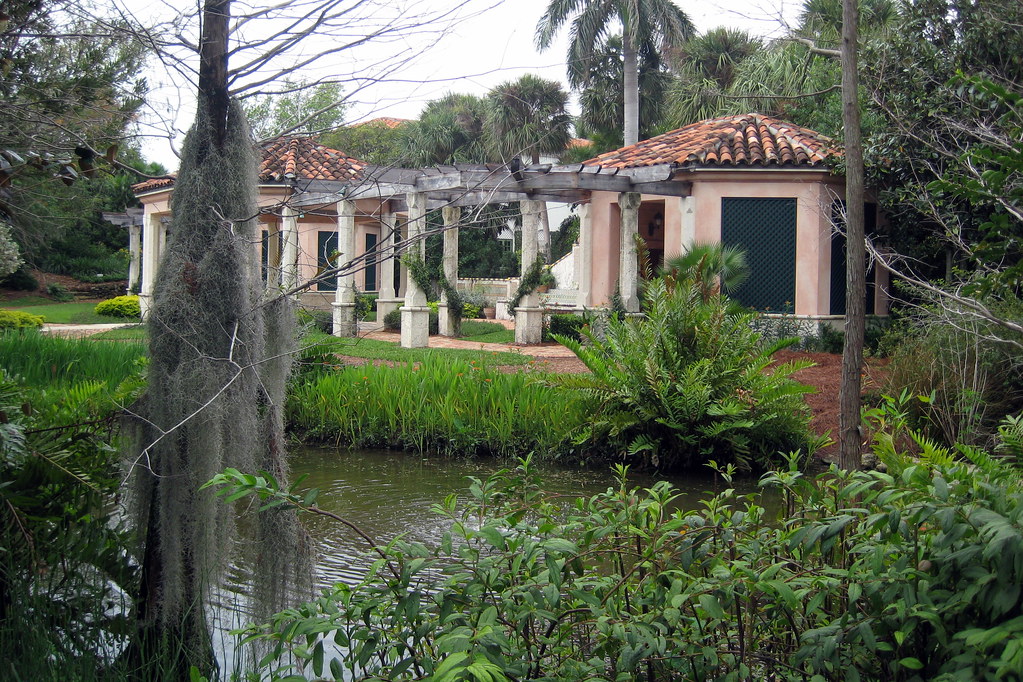
Photo and Description by Wally Gobetz
Founded in 1994 by The Preservation Foundation of Palm Beach, Pan’s Garden is a unique botanical garden consisting of over 300 native Florida plant species. Since its inception the garden has been home to numerous interdisciplinary educational programs designed to provide students with a glimpse into the wonders of plants and the importance of preserving the world’s natural resources.
The one-half acre garden sits on site that was previously a parking lot and a derelict home. Today, instead of asphalt, the garden features over 300 species of native trees, shrubs, grasses and wild flowers, many of which are endangered. These are incorporated into upland and wetland areas designed to display their naturally occurring relationships to one another. Each year cultivars of native species are planted in seasonal floral display areas to highlight possible choices for home landscaping.
A significant feature of Pan’s Garden is the Casa Apava wall. The historic tile wall, which dates to the 1920s, was rescued from the Casa Apava estate on South Ocean Boulevard and forms a dramatic backdrop for the western boundary of the garden.

Photo and Description by Wally Gobetz
On September 16, 1928, a hurricane came ashore near the Jupiter Lighthouse and traveled west across Palm Beach County to Lake Okeechobee. This deadly hurricane destroyed hundreds of buildings and left millions of dollars in property damage. Many of the 1,800 to 3,000 fatalities occurred when the Lake Okeechobee dike collapsed, flooding the populated south side of the lake.
Approximately 1,600 victims were buried in a mass grave in Port Mayaca in Martin County. In West Palm Beach, 69 white victims were placed in a mass grave in Woodlawn cemetery and approximately 674 black victims were buried in this mass grave in the City’s pauper’s burial field at Tamarind Avenue and 25th Street. Many others were never found.
On September 30, 1928, the City proclaimed an hour of mourning for the victims with memorial rites conducted simultaneously at each of the burial sites. Two thousand persons attended the ceremonies at the pauper’s cemetery, where noted black educator and activist Mary McLeod Bethune (1876-1955) read the Mayor’s proclamation. The mass grave at Woodlawn Cemetery was subsequently identified by a marker. This burial site was not again recognized until 1991, when a Yoruba (Nigerian religious) ceremony was held here.

Photo and Description by Wally Gobetz
The works of H.R.H. Prince Monyo Mihailescu-Nasturel Herescy, a prolific sculptor and descendent of the Romanian royal family, are exhibited by Gallery Via Veneto off Worth Avenue.

Photo and Description by Wally Gobetz
The Society of the Four Arts is a nonprofit cultural organization founded in 1936 by a group of prominent Palm Beach residents to meet the cultural needs of the growing resort community. The four arts which constitute the Society?s mission are music, drama, literature, and art.
The sculpture garden of the Society honors the memory of Philip Hulitar, a prominent American couturier and Palm Beach resident who restored several historic houses here. In March 1965, the Four Arts members purchased the vacant lot at the corner of Royal Palm Way and Cocoanut Row from the Walton family. In 1967 and 1968, the Society bought the two adjoining lots. By 1979 the combined lots were still unimproved, when Mrs. John Clifford Folger, then chairman of The Four Arts Landscape Committee, discussed with Philip Hulitar the need for beautification, and a plan emerged to establish a sculpture garden.

Photo and Description by Wally Gobetz
Reaching (1963), a bronze sculpture by Edward Fenno Hoffman III (American, 1916 – 1991), was given in memory of Margaret Richardson Trout, by Her Family, on November 21, 1990. The 4-foot tall sculpture depicts a woman seated on a rectangular column with her knees bent and only her toes touching the ground. Her hair is in a bun, and her upper torso is bent forward over a child, her hands holding the child’s legs. The child’s face is over the woman’s knees, with the proper right hand on the woman’s proper right hand. A frog is sitting on a lily pad facing the woman.
The Society of the Four Arts is a nonprofit cultural organization founded in 1936 by a group of prominent Palm Beach residents to meet the cultural needs of the growing resort community. The four arts which constitute the Society’s mission are music, drama, literature, and art.
The sculpture garden of the Society honors the memory of Philip Hulitar, a prominent American couturier and Palm Beach resident who restored several historic houses here. In March 1965, the Four Arts members purchased the vacant lot at the corner of Royal Palm Way and Cocoanut Row from the Walton family. In 1967 and 1968, the Society bought the two adjoining lots. By 1979 the combined lots were still unimproved, when Mrs. John Clifford Folger, then chairman of The Four Arts Landscape Committee, discussed with Philip Hulitar the need for beautification, and a plan emerged to establish a sculpture garden.

Photo and Description by Wally Gobetz
The neoclassical yellow brick Palm Beach County Courthouse was built to the design of Wilber Talley in 1916. An east annex, also designed by Talley, was added in 1927 and other additions in 1955. A 135,000-square-foot wrap-around expansion in 1972, designed by Jefferson N. Powell and Donald Edge mummified the original structure and part of the original building was given away or destroyed. The Palm Beach Memorial Park Cemetery located in Lantana received some of its 12 masonry columns. Six of the columns also stand at the entrance to the Hillcrest Memorial Park Cemetery in southern West Palm Beach. After many individual and collective efforts to save the historic courthouse from demolition, led by community preservationists and Historical Society leaders, the Board of County Commissioners voted in April 2002 to preserve and share the building with the public, committing to pay the estimated $18.5 million to restore the building to its original, neo-classical grandeur.
The opportunity paved the way for the Historical Society of Palm Beach County to request space for the countys first history museum inside the restored courthouse. The museums design plans include permanent and temporary exhibit space, each reflecting the influence of the many cultures in Palm Beach Countys diverse history, from the earliest Native American inhabitants to the present day. A central component to the museum experience will be a visit to the seat of the countys judicial and legislative beginnings, the courthouses two story, 2,897 square foot historic courtroom, located on the third and fourth floors in the center of the building.

Photo and Description by Wally Gobetz
The Chesterfield Hotel at 363 Cocoanut Row, was built as Mediterranean Revival style bed and breakfast by E.F. Munden in 1926. It was originally called the Lido-Venice, but shortly renamed the Vineta Hotel in 1928. The hotel was renovated in 1937 by John L. Volk and has since undergone annual refurbishments–none of which have compromised the historic character of the property. In 1989, the hotel was renamed the Chesterfield, having intermittently been called the Palm Court Hotel, and is today a member of the Red Carnation Hotel Collection and Small Luxury Hotels of the World.

Photo and Description by Wally Gobetz
Palm Beach Town Hall, at 360 South County Road, was built of Spanish Colonial/Mission Revival design by Harvey and Clark in 1925. Town Hall was two separate buildings until 1960, when noted Palm Beach Architect John L. Volk seamlessly joined them with a new central addition. In 1988, Keystone Restoration was commissioned by the Town of Palm Beach to implement architect Jeffery Smith’s exacting historic restoration.
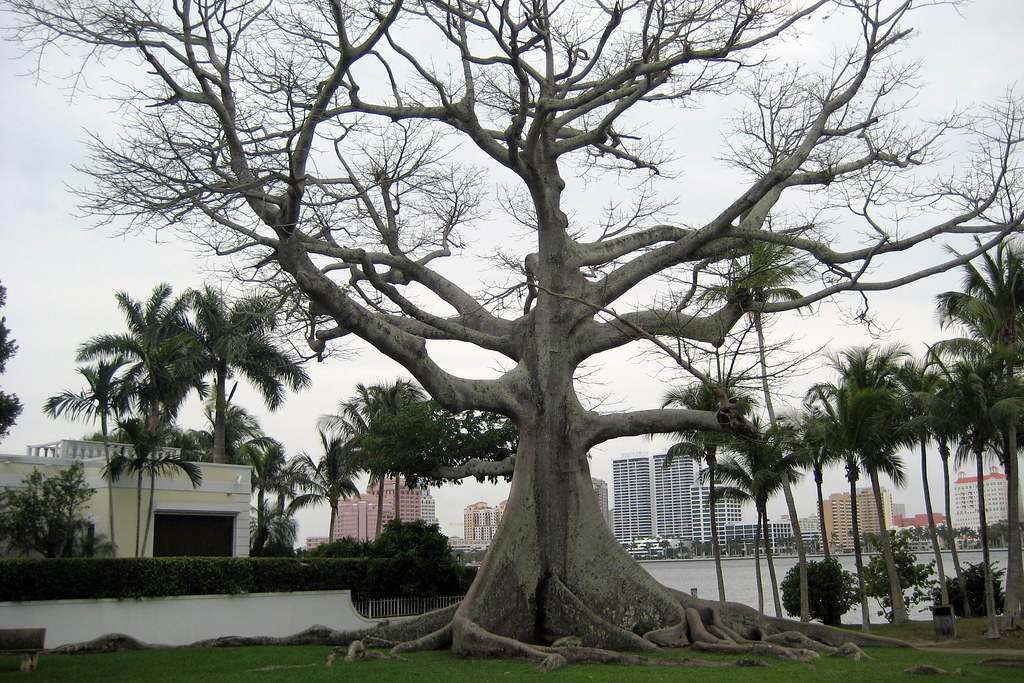
Photo and Description by Wally Gobetz
Lake Trail, built in 1894 by Henry Morrison Flagler on the Intracoastal side of Palm Beach features the Sea Gull Cottage, Flagler’s Whitehall mansion, and this huge kapok tree with its unusual ribbonlike roots.

Photo and Description by Wally Gobetz
Old Key Lime House, overlooking the intracoastal waterway at 300 East Ocean Avenue, is the second house house in Lantana and was built by the Lyman family in the summer of 1889. Lantana came into existence after the Indian wars from 1835-1842. By 1873, there were only ten people living around Lake Worth. Founding father, storekeeper and postmaster, Morris Lyman named the town that was incorporated in 1921.
The Old House Restaurant was established in December 1989. Upon refurbishing, the original wood was found–Dade County Pine which is no longer manufactured. Recently the Old House changed the décor and menu to fit the Key West/Island Style. Hence the name change to Old Key Lime House, a Seafood Grill and Bar. It is renown for its Key Lime Pie.

Photo and Description by Wally Gobetz
Worth Avenue, sometimes referred to as the Rodeo Drive of Florida, is a famous upscale shopping district stretching four blocks from Lake Worth to the Atlantic Ocean. The street first became fashionable after the construction in 1918 of the Everglades Club. Worth Avenue also includes smaller alleyways, known as Vias, off the main avenue.
The epitome of Palm Beach style, the street has approximately 250 shops, boutiques, restaurants and art galleries, including Neiman Marcus, Cartier, Louis Vuitton, Tiffany & Co., Hermès, Polo Ralph Lauren, Gucci, Chanel, Loro Piana, Brooks Brothers, Salvatore Ferragamo, Valentino, Vilebrequin, and Lacoste. An open-air mall, The Esplanade, lies at the eastern end of Worth Avenue. The Esplanade offers a variety of upscale shops anchored by department store Saks Fifth Avenue.
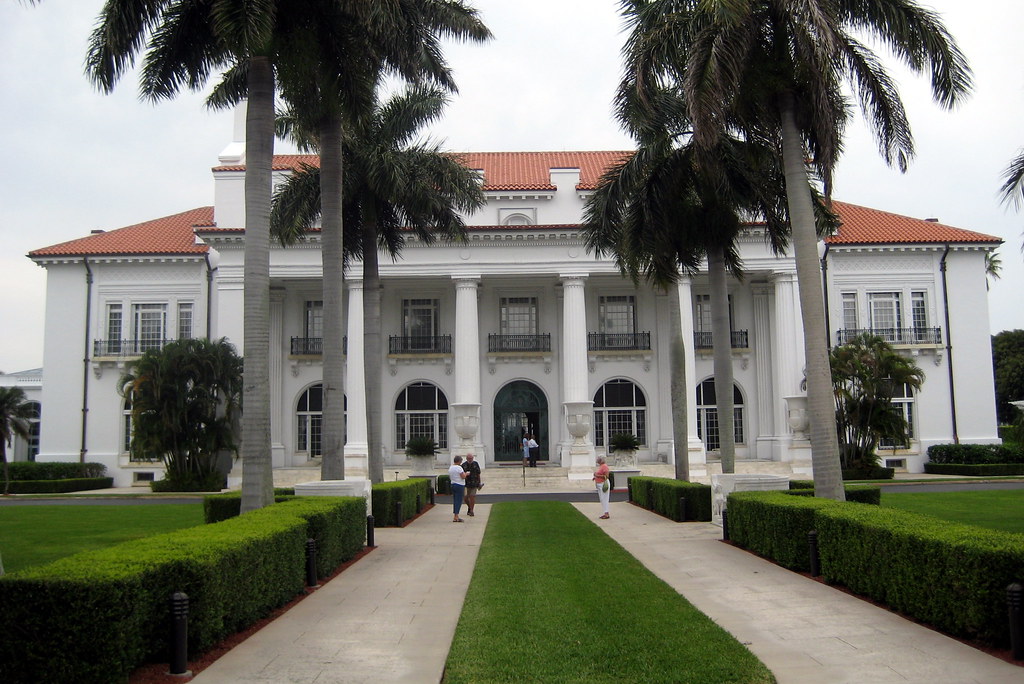
Photo and Description by Wally Gobetz
 In 1902, the Co-Founder of Standard Oil, Railroad Baron and The Father of Florida Tourism, Henry Flagler, built his Palm Beach estate, Whitehall, as a wedding present for his third wife.
Whitehall was a 55-room, 60,000-square-foot (5,600 m²) beaux arts home designed by the New York-based firm of Carrère and Hastings. The façade of Whitehall is marked by massive marble columns and topped with a red barrel tiled roof. Built around the central courtyard, the house consists of two floors, an attic and a basement. It was Flagler’s “winter retreat” and established the Palm Beach “season” of about 8–12 weeks, for the wealthy of America’s Gilded Age.
Whitehall, Palm Beach, is open to the public as the Henry Morrison Flagler Museum and his private railcar No. 91 is preserved inside a Beaux Arts pavilion built to look like a 19th Century railway palace.
Henry Flagler and the Birth of Florida Tourism

Henry Morrison Flagler (January 2, 1830 – May 20, 1913) was an American industrialist, the co-founder of Standard Oil, a Railroad Baron and one of the richest men on earth. He just also happens to be the person who created Florida tourism, built the world’s most luxurious hotel, built a train across and ocean and helped found the cities of Palm Beach, West Palm Beach and Miami.
It’s an amazing tale.
Travel Tips and Destinations


You may also enjoy these pages about Palm Beach and other destinations:
- Beautiful Palm Beach Florida – Palm Beach may have the glitz and glamor, but it has a sleepy and relaxing vibe, making it quite attractive to snowbird retirees getting away from the brutal winter. But if you are a young traveler, don’t overlook the fact that there are also many “happening places” all throughout the town.
- Palm Beach, Florida from Above – Enjoy a rare look at the homes and playgrounds of the very rich and famous in Palm Beach and West Palm Beach, Florida.
- What to Do in Palm Beach, Florida – Discover your perfect Palm Beach Vacation in this video from The New York Times’ 36 Hours Travel Series.
- More Coming Soon
Tropical Style: Private Palm Beach


Among the twenty homes that are featured in this lavish volume are those of Dorothy Spreckels Munn and Lilly Pulitzer Rousseau. All the most renowned Palm Beach architects — Addison Mizner, Maurice Fatio, Howard Major, and Belford Shoumate — are represented.
But author Jennifer Ash also takes us off the beaten path to fascinating residences known to natives alone: an artist’s bungalow on the bohemian Root Trail, a luxuriously appointed yet fully seaworthy yacht, a cozy retreat in a landmark church. And while relating the gossip-packed history of many of the island’s famous residents, she gives us a guided tour of interiors created by both local and world-renowned designers, including David Easton and Juan Pablo Molyneux.
From the rococo splendor of Mar-a-Lago — designed by Joseph Urban for Marjorie Merriweather Post and now owned by Donald Trump — to the ultra-modern chic of a house by Richard Meier, Private Palm Beach affords intimate access to life behind the island’s meticulously manicured hedges.
Click HERE Now to Get Tropical Style: Private Palm Beach
Additional Information Courtesy of Wikipedia
July 14, 2015 @ 12:36 am
I believe twice a week is too much. I’m enjoying reading all the information which makes me want to plan a trip. I probably won’t be able to read it all twice a week. I love the pictures. They’re very inviting. My general impression is that Palm Beach is for the wealthy, at least the restaurants that are featured. It would help to include some indication of the price of a typical lunch or dinner. Also noted some grammatical and spelling errors in the text, e.g. “and” instead of “an”, “is” instead of “are”. I don’t like the ads interspersed in the info. Like the links to more info.
July 14, 2015 @ 9:39 pm
Jo Ellen,
Thank you. We are working on a plan to get recommendations and prices into more places. Sorry about the typos – Those kind are hard to catch.
James