
Photo by Timothy Wildey
Henry Flagler and the Birth of Florida Tourism
In the early days of the United States, Florida was frontier wilderness. A place of jungles, swamps, dangerous animals and Indians. About the only people who came to Florida were hardy souls like fishermen, trappers, adventurers and pirates.
But finally, in the early 19th century as Americans settled into their vast new land, other, less adventurous people started arriving in Florida.
The first to come were the sick. People with all manner of ailments flocked down to be restored to health in its warm climate and clear springs. Sportsman and naturalists were the next to come looking for exotic animals to shoot or photograph. The country’s well-to-do were next to come. The climate and tropical setting made it particularly attractive to those who could afford to “winter” in cities like St. Augustine, Tampa, and Miami. However, the difficulties of getting to Florida, and the inevitable hardships and costs of taming the jungles and swamps, kept Florida a playground for the idle rich until after the Civil War. Finally in the late 1800s Florida was opened up to everyone and the tourists started coming down.
And that is all thanks to Henry Flagler.

Henry Morrison Flagler (January 2, 1830 – May 20, 1913) was an American industrialist and co-founder of Standard Oil.
In the mid-1800s, through his business Flagler became acquainted with John D. Rockefeller, then a commission agent for a grain company. In 1867 Rockefeller approached Flagler about going into the oil business. Flagler obtained $100,000 (equivalent to $1.7 million in 2015) from a family member and the two form a partnership that eventually grew into the Standard Oil Corporation.
Standard Oil monopolized quickly and took America by storm, thanks in large part to Henry Flagler. When John D. Rockefeller, who eventually became the world’s richest man (worth a staggering $336 billion in 2007 dollars) and the first American billionaire, was asked if the Standard Oil company was the result of his thinking, he answered, “No, sir. I wish I had the brains to think of it. It was Henry M. Flagler.
Flagler, while he didn’t become as rich as Rockefeller, became fabulously wealthy himself, eventually amassing a personal fortune in excess of $60 million by the time of his death in 1913 (equivalent to $1.4 Billion in 2015)
With this vast fortune Flagler chose to open up Florida’s East Coast to the masses.
 On the advice of his physician, Flagler traveled to Jacksonville for the winter with his first wife who was quite ill. Unfortunately, it was not the cure they had hoped and she died in 1879. Two years later he married again.
Despite his first wife’s illness and death, Flagler seems to have enjoyed his time in Florida, because after their wedding, he took his new wife to Saint Augustine. Flagler found the city charming, but the hotel facilities and transportation systems inadequate.
Franklin W. Smith had just finished building Villa Zorayda and Flagler offered to buy it for his honeymoon. Smith would not sell, but this planted a seed in Flagler’s mind.
Flagler had a vision for Florida’s future.

Photo by Rich Jacques
In 1885 Flagler gave up his day-to-day involvement in Standard Oil (although he remained on the board) to pursue his interests in Florida. He returned to St. Augustine and made Smith another offer. If Smith could raise $50,000, Flagler would invest $150,000 and they would build a new hotel together. Smith couldn’t come up with the funds, so Flagler began construction of the 540-room Ponce de León Hotel by himself. Although he eventually spent several times his original estimate, The Ponce de León Hotel was an instant success when it opened on January 10, 1888.
Realizing the need for a sound transportation system to fill this massive new hotel, and perhaps seeing further into the future, Flagler began to purchase short line railroads in what would later become known as the Florida East Coast Railway.
Flush with success, money and a dream of Florida’s future, in the early 1890s Flagler completed the 1,100-room Royal Poinciana Hotel on the shores of Lake Worth in Palm Beach and in 1894 extended his railroad to take people to it, founding the cities of Palm Beach and West Palm Beach in the bargain. When he began buying tracts of land there “at any price,” Palm Beach was just a desolate barrier island on Florida’s Atlantic coast. The Royal Poinciana Hotel was at the time the largest wooden structure in the world. It was so big that its hallways totaled more than three miles (5 kilometers) in length and bellhops delivered messages and packages from the front desk to guests’ rooms by bicycle. Although it closed in 1934, and was torn down by Labor Day of 1935 this grand hotel helped establish Palm Beach as a world-class vacation destination.

In 1896, Flagler built the Palm Beach Inn (renamed Breakers Hotel Complex in 1901 because guests often requested rooms “over by the breakers”) overlooking the Atlantic Ocean in Palm Beach.
Flagler originally intended West Palm Beach to be the terminus of his railroad system, but in 1894 and 1895, severe freezes hit the area, causing Flagler to reconsider. Sixty miles south, the area today known as Miami was reportedly unharmed by the freeze. To further convince Flagler to continue the railroad to Miami, he was offered land in exchange for laying rail tracks from private landowners, the Florida East Coast Canal and Transportation Company, and the Boston and Florida Atlantic Coast Land Company.
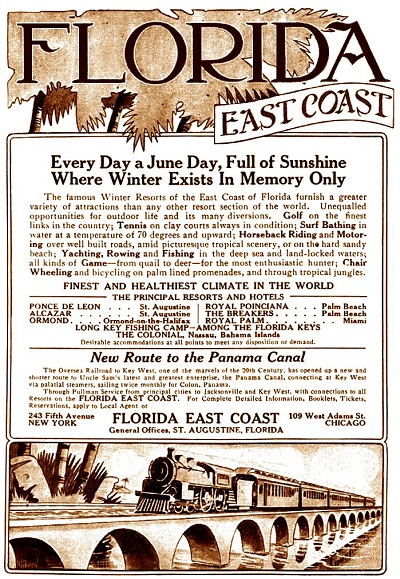
Photo and Original Poster are in the Public Domain
Such incentive led to the development of Miami, which was an unincorporated area at the time. Flagler encouraged fruit farming and settlement along his railway line and made many gifts to build hospitals, churches and schools in Florida.
By 1896, Flagler’s railroad, the Florida East Coast Railway, reached Biscayne Bay. Flagler dredged a channel, built streets, instituted the first water and power systems and financed the city’s first newspaper, The Metropolis. When the city was incorporated in 1896, its citizens wanted to honor the man responsible for its growth by naming it “Flagler”. He declined the honor, persuading them to use an old Indian name, “Mayaimi”. Flager became known as the Father of Miami, Florida.
The railroad eventually reached all the way to Key West. Although the railway closed after being heavily damaged and partially destroyed in the Labor Day Hurricane of 1935, the Overseas Highway to Key West that is used today was built using much of the remaining railway infrastructure.
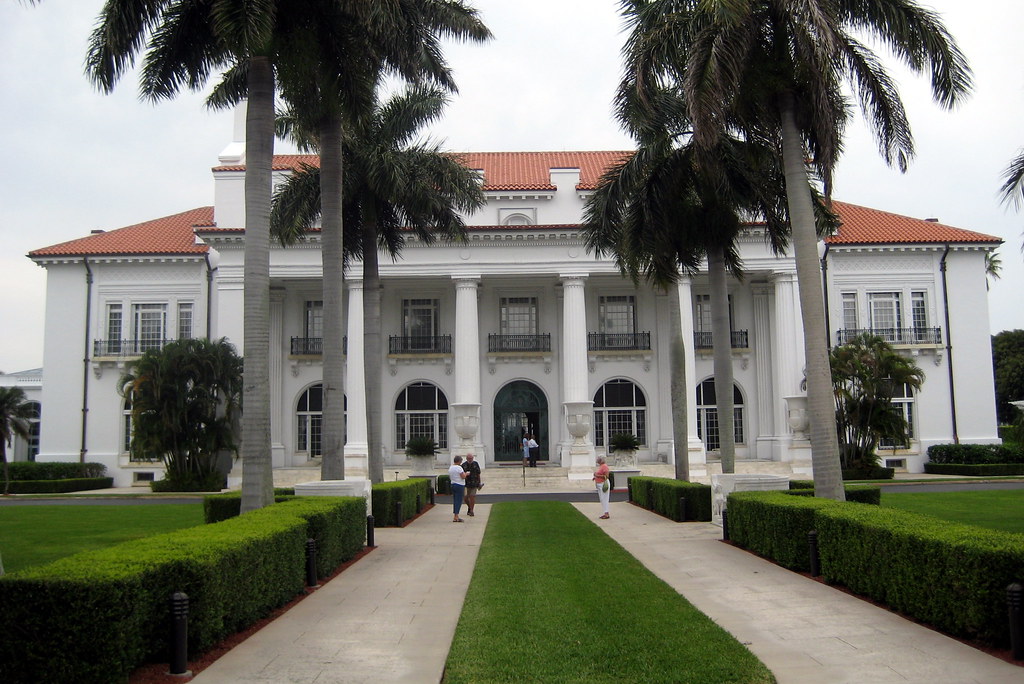
Photo and Description by Wally Gobetz
In 1902 Flagler built his Palm Beach estate, Whitehall, as a wedding present for his third wife. Whitehall (now the Flagler Museum) is a 55-room, 60,000-square-foot (5,600 m²) beaux arts home designed by the New York-based firm of Carrère and Hastings. It was Flagler’s “winter retreat” and established the Palm Beach “season” of about 8–12 weeks, for the wealthy of America’s Gilded Age.
Whitehall, Palm Beach, is open to the public as the Henry Morrison Flagler Museum and his private railcar No. 91 is preserved inside a Beaux Arts pavilion built to look like a 19th Century railway palace.
Despite turning down the chance to have Miami named after him, Flagler’s name can be seen all over the East Coast of Florida that he helped to create and popularize. Miami’s main east-west street, is named Flagler Street, and is the main shopping street in Downtown Miami. Flagler College and Flagler Hospital are named after him in St. Augustine as well as Flagler County, Florida and Flagler Beach, Florida.

Photo by Ape Lad
Over thirty years, Flagler had invested about $50 million in railroad, home, and hotel construction and gave to suffering farmers after the freeze in 1894. When asked by the president of Rollins College in Winter Park about his philanthropic efforts, Flagler reportedly replied, “I believe this state is the easiest place for many men to gain a living. I do not believe any one else would develop it if I do not … but I do hope to live long enough to prove I am a good business man by getting a dividend on my investment.”
When looking back at Flagler’s life, after his death on May 20, 1913, George W. Perkins, of J.P. Morgan & Co., reflected, “That any man could have the genius to see of what this wilderness of waterless sand and underbrush was capable and then have the nerve to build a railroad here, is more marvelous than similar development anywhere else in the world.”
You may also enjoy these pages about Florida and other destinations:
- Beautiful Palm Beach Florida – This town in Florida may have the glitz and glamor, but it has a sleepy and relaxing vibe, making it quite attractive to snowbird retirees getting away from the brutal winter. But if you are a young traveler, don’t overlook the fact that there are also many “happening places” all throughout the town.
- Travel Picture Book – Beautiful and Historic Palm Beach, Florida – Palm Beach, Florida is a vacationer’s paradise. But there is more to see and do than just the beach. Let the incredible Wally Gobetz, photographer, take you on a photo tour of his favorite sites in Palm Beach with interesting detailed descriptions of each one.
- Pet Friendly Vacations – The Florida Keys – For a pet friendly tropical island vacation, look no farther than the beautiful Florida Keys! From Key Largo to Key West, this spectacular drive has numerous places to pull off for a stroll or photo with your pet. And most businesses and hotels welcome pets, too.
- Palm Beach, Florida from Above – Enjoy a rare look at the homes and playgrounds of the very rich and famous in Palm Beach and West Palm Beach, Florida.
- What to Do in Palm Beach, Florida – Discover your perfect Palm Beach Vacation in this video from The New York Times’ 36 Hours Travel Series.
- More Coming Soon
Read More About The Amazing Life of Henry Flagler
Last Train to Paradise


Last Train to Paradise is acclaimed novelist Les Standiford’s fast-paced and gripping true account of the extraordinary construction and spectacular demise of the Key West Railroad—one of the greatest engineering feats ever undertaken, destroyed in one fell swoop by the Labor Day hurricane of 1935.
Brilliant and driven entrepreneur Henry Flagler’s dream fulfilled, the Key West Railroad stood as a magnificent achievement for more than twenty-two years, heralded as “the Eighth Wonder of the World.”
Standiford brings the full force and fury of 1935’s deadly “Storm of the Century” and its sweeping destruction of “the railroad that crossed an ocean” to terrifying life.
Last Train to Paradise celebrates a crowning achievement of Gilded Age ambition in a sweeping tale of the powerful forces of human ingenuity colliding with the even greater forces of nature’s wrath.
Click HERE Now to Get Last Train to Paradise
Article Compiled and Written by Mark Hester from Information Courtesy of Wikipedia